
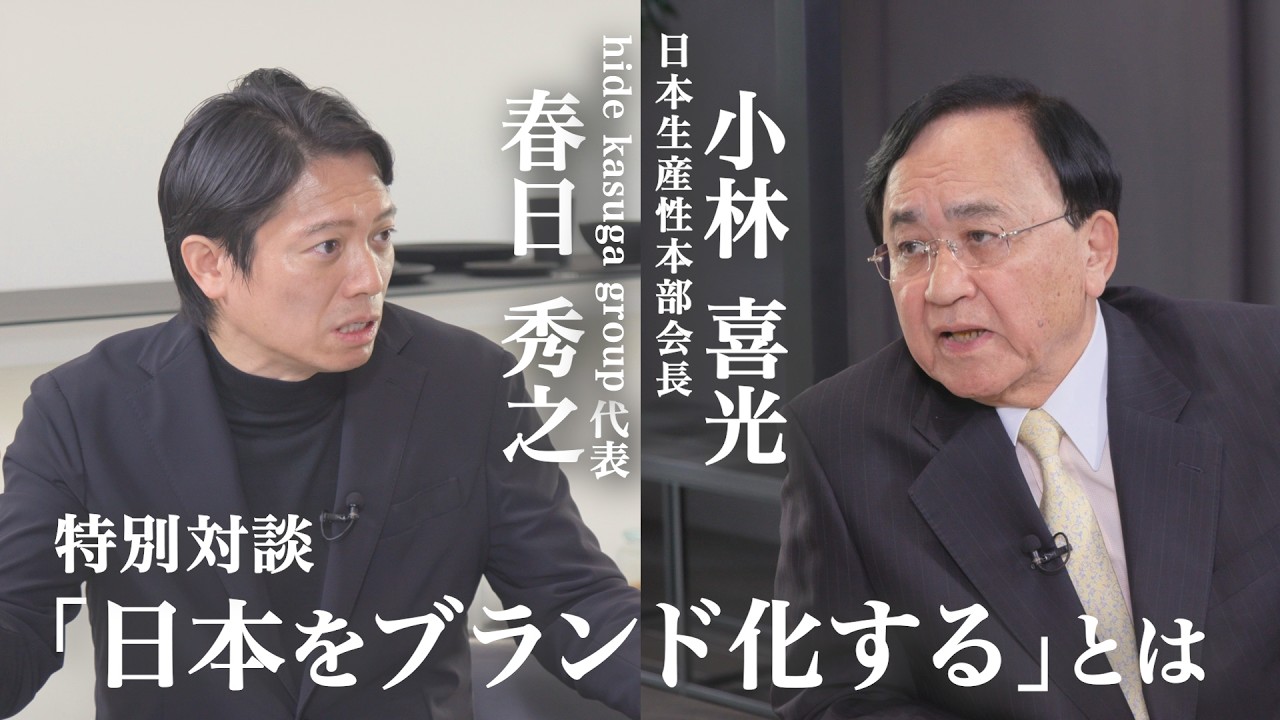
We are pleased to announce the release of a special video interview featuring Mr. Yoshimitsu Kobayashi, Chairman of the Japan Productivity Center, and Mr. Hideyuki Kasuga, Representative of the Hide Kasuga Group.
"Special Interview: Hideyuki Kasuga × Yoshimitsu Kobayashi, Chairman of the Japan Productivity Center: 'What Does It Mean to 'Brand Japan'?'"
Watch it here ▼
■ Discussion Topic: What Does “Branding Japan” Mean?
Discussion Topic: What Does “Branding Japan” Mean?
After a period of rapid economic growth following World War II, Japan grew to become one of the world’s leading economic powers. However, due to factors such as prolonged deflation and a decline in international competitiveness, Japan is currently facing a major turning point.
What is needed to break out of this situation and get Japan growing again?
In this interview, we welcome Mr. Yoshimitsu Kobayashi, Chairman of the Japan Productivity Center, to discuss the unique value of human beings in the age of AI and the branding strategies Japanese companies should pursue. We delve into the importance of enhancing the added value of products by combining elements such as design, sensibility, and regional culture and history—precisely because Japan possesses outstanding manufacturing technology.
Furthermore, we will explore the path to Japan’s revitalization from a wide range of perspectives—from the untapped potential in regional areas and expansion into global markets to the role of education in nurturing the talent that will shape Japan’s future.
[Main Topics]
・The Value of Humans in the Age of AI: The Importance of Human Sensitivity, Skills, Ethics, and Trust—Qualities That AI Cannot Replace
・Branding for Japanese Companies: A strategy for enhancing the added value of products by combining manufacturing expertise with design and aesthetic sensibility
・Untapped Potential in Regional Areas: New forms of manufacturing that integrate traditional crafts, local culture, history, and intellectual property, and their expansion into global markets
・Education for the Next Generation: What is necessary to foster curiosity about the world and a spirit of challenge, and to produce leaders who will shape Japan’s future
Japan still holds a wealth of untapped potential that can be shared with the world. What is needed to identify that value, refine it, and share it with the world? This is a thought-provoking conversation that offers many insights as we consider Japan’s future. We hope you’ll take the time to watch it.
■ Profile
Mr. Yoshimitsu Kobayashi
The 8th Director-General of UNESCO (United Nations Educational, Scientific and Cultural Organization)
Born in Yamanashi Prefecture. Ph.D. in Science. In 1971, he completed the Master’s program in Correlated Physical Sciences at the Graduate School of Science, University of Tokyo. After studying abroad in the Department of Physical Chemistry at the Hebrew University (Israel) and the Department of Chemistry at the University of Pisa (Italy), he joined Mitsubishi Chemical Industries (as it was then known).After serving as President and Representative Director and Chairman of the Board of Directors at Mitsubishi Chemical Holdings (as it was then known), he served as Chairman of the Board of Directors at Tokyo Electric Power Holdings from 2021 to 2026 and has been Chairman of the Japan Productivity Center since 2025. He also serves as a director of Rapidus and the University of Tokyo’s Organization for the Promotion of Industry-Academia Collaboration.He has held various public offices, including serving as a private-sector member of the Council on Economic and Fiscal Policy, the Council on Industrial Competitiveness, and the Council for Science, Technology and Innovation; as President of the Japan Academy of Engineering; and as Representative Director of the Japan Association of Corporate Executives.
Hideyuki Kasuga
hide kasuga group President
Born in Nagano Prefecture. Doctor of Engineering. Representative of the “Hide Kasuga Group,” which promotes the development of a circular economy (CE) under the banner of “welfare.” Founder and owner of the eco-friendly brands “BLANC BIJOU PARIS®,” “hide k 1896®,” and “TRANSWOOD®.”He is working to implement the circular economy in society, ranging from the development of environmentally harmonious materials and products to the establishment of circular schemes. He also provides consulting services to various companies on building circular economies by leveraging the expertise gained from his own brands. In the field of education, he is engaged in talent development as a Specially Appointed Professor at Shinshu University and a Visiting Lecturer at Waseda University. He is also the proponent of “Reiwa Modernism®,” a lifestyle that blends the old and the new with Japan at its core.
